
Have you ever wondered whether a Robot Dog, a robotic dog and a robo dog are actually different? As robotics becomes increasingly popular in Singapore, these terms are appearing in searches for smart gadgets, educational toys, AI-powered machines and interactive entertainment. If you are searching for a Robot Dog Singapore experience for your children, corporate team or next special event, understanding these terms can help you choose the right option. Although the three expressions are often used interchangeably, their meaning can vary depending on the technology, product or activity being discussed. In this guide, we explain the differences, explore how robot dogs work, and discover how RoboDog laser tag brings robotics-inspired excitement to events in Singapore.
What Is a Robot Dog?
A robot dog is a machine designed to resemble a real dog in appearance, movement or behaviour. Depending on its design, it may walk on four legs, respond to commands, avoid obstacles, perform tricks or interact with people.
Unlike a living dog, a robot dog operates using electronic components, motors, sensors and programmed instructions. More advanced models May also use artificial intelligence (AI) to recognise objects, interpret commands or adapt to their surroundings.
However, not every robot dog has AI. Some are simple toys controlled by a remote, while others are sophisticated robotic systems designed for research, inspection or industrial applications.
In everyday life, robot dogs generally fall into several categories:
· Robot dog toys: Interactive gadgets designed primarily for children and home entertainment.
· Educational robot dogs: Programmable machines that help students explore coding, robotics and problem-solving.
· AI robot dogs: More advanced machines that use AI-enabled features to interpret information or respond to their environment.
· Industrial robot dogs: Four-legged robotic platforms that can inspect challenging environments or support specialised operations.
· Entertainment robot dogs: Interactive robotic characters used for demonstrations, events, games and audience engagement.
Therefore, the term "robot dog" describes a broad category rather than one specific product.
For Singapore families, schools and businesses, the best choice depends on the intended purpose. A child may want a playful robot dog toy, whereas a school may prefer a programmable model. Meanwhile, a company organising a team-building event might find an interactive RoboDog activity more engaging than simply watching a robot demonstration.
Robot Dog vs Robotic Dog vs Robo Dog: Key Differences Explained
The biggest difference between these three expressions is usually how they are used rather than the underlying technology.
A robot dog and a robotic dog generally refer to the same type of machine. By comparison, robo dog is a shorter, more casual expression that is frequently used in product names, entertainment and marketing.
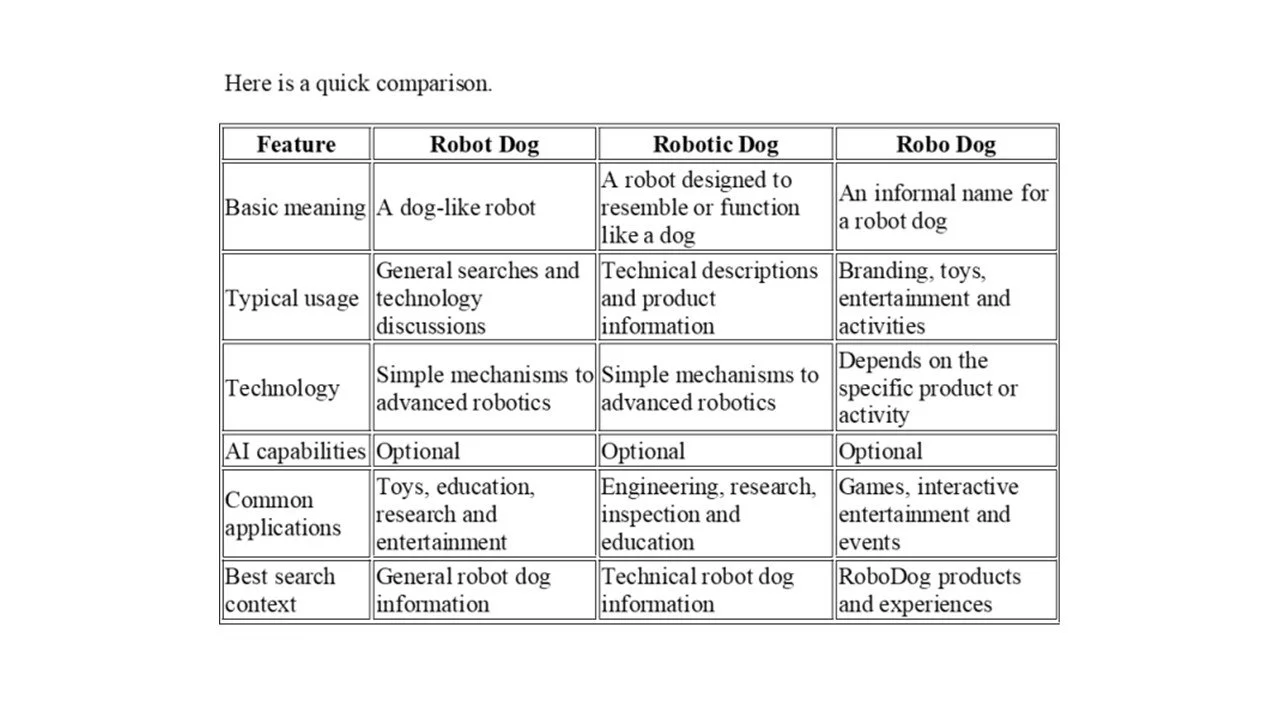
Importantly, none of these names automatically guarantees that a machine has artificial intelligence, autonomous movement or advanced sensors. You should always check the specifications of the actual product.
1. What Does Robot Dog Mean?
"Robot dog" is the most straightforward and widely understandable expression. It describes a robotic device that resembles a dog or performs dog-like movements.
For example, a remote-controlled four-legged toy can be called a robot dog, even if it only walks forward, turns and makes sounds. Likewise, a sophisticated quadruped robot used for inspection can also be described as a robot dog.
Because the term covers such a broad range of products, it is useful when researching robotic pets, robot dog toys, educational robotics or AI-powered machines.
2. What Does Robotic Dog Mean?
"Robotic dog" places slightly more emphasis on the machine's robotic construction or functionality.
You may encounter this phrase in technical articles, engineering discussions, educational materials and descriptions of machines designed for specialised tasks.
Nevertheless, the expression does not necessarily mean that the machine is more advanced than a product marketed as a robot dog. Both descriptions can refer to the same device.
For example, a four-legged machine equipped with cameras and sensors may be described as a robotic dog in a technical report. In a general conversation, however, most people would simply call it a robot dog.
3. What Does Robo Dog Mean?
"Robo dog" is a shorter, friendlier and more informal term. It is particularly suitable for toys, entertainment products, character names and interactive experiences.
The spelling "Robodog" is also used as a single word, while "RoboDog" may appear as a branded name.
In Singapore, this distinction is relevant when searching for TAG TEAM's RoboDog activities. TAG TEAM introduces RoboDog as an interactive event experience featuring activities such as obstacle courses, fetch-style games and robotic demonstrations. Its corporate event offering also combines RoboDog with laser tag missions.
You can explore the experience on TAG TEAM's RoboDog team-building activity page.
Ultimately, a robo dog is not automatically a different type of machine. The name may simply make the technology sound more approachable and entertaining.
How Does a Robot Dog Work?
A robot dog combines mechanical components and electronic systems to produce movement and, in some models, interactive behaviour.
Although the design differs from one model to another, most functional robot dogs rely on several important components.
Motors and mechanical legs
First, electric motors power the robot's legs and joints. By controlling these motors in a coordinated sequence, the robot can stand, walk, turn or perform programmed movements.
More advanced quadruped robots may adjust their steps to maintain balance on uneven ground. However, basic robot dog toys often operate using simpler, predetermined movement patterns.
Sensors and environmental awareness
Next, sensors provide information about the robot's surroundings. Depending on the model, these may include cameras, distance sensors, motion sensors or other sensing equipment.
For example, a robot dog with obstacle-detection sensors may stop or change direction when it encounters an object. A more sophisticated system may use cameras and computer vision to recognise selected objects.
Nevertheless, the presence of sensors does not mean the robot can understand every situation or move safely without supervision.
Software and control systems
Software determines how the robot responds to commands and sensor information. Some models follow instructions from a remote control or mobile application, while others execute pre-programmed routines.
Educational models may allow users to create their own commands through visual programming tools or code. As a result, students can learn how instructions translate into physical actions.
Artificial intelligence and machine learning
Some advanced robot dogs incorporate AI techniques to process visual information, interpret commands or navigate their surroundings.
An AI robot dog may have capabilities that a basic toy lacks. However, AI features vary considerably between products, and marketing descriptions should not be treated as proof of specific capabilities.
When choosing an AI robot dog, check whether its advertised features include genuine speech recognition, object recognition, autonomous navigation or other functions you need.
What Is the Difference Between a Robot Dog Toy and an AI Robot Dog?
Although the two products may look similar, a robot dog toy and an AI robot dog can offer very different experiences.
Robot dog toy: Simple entertainment
A robot dog toy is generally designed for play. It may walk, bark, wag its tail, dance, respond to buttons or follow a limited set of commands.
Some toys are controlled by a remote, while others react to sounds or simple gestures.
These toys are often suitable for introducing younger children to the idea of robotics. Moreover, they can encourage imaginative play and curiosity about how machines work.
However, parents should check the recommended age, battery requirements, small parts, charging instructions and manufacturer's safety guidance before purchasing one.
AI robot dog: More interactive functionality
An AI robot dog may combine sensors, software and AI-based processing to provide a more adaptive experience.
Depending on its capabilities, it may recognise objects, respond to spoken instructions, navigate around obstacles or learn to perform certain tasks.
For instance, an educational robot dog might allow students to experiment with coding and observe how a machine responds to different instructions.
Even so, not every product described as an AI robot dog offers all these functions. Some models rely mainly on pre-programmed responses, so reviewing the specifications is essential.
Which option should you choose?
The right option depends on your goals.
Choose a robot dog toy if you want straightforward entertainment or an introduction to robotic pets. Consider a programmable educational model if your main objective is to teach coding and problem-solving. On the other hand, an advanced robot dog may be more suitable for demonstrations or specialised technical applications.
If your goal is to organise a lively group activity rather than purchase a machine, an interactive RoboDog event can provide a different kind of experience altogether.
What Is the Best Robo Dog for Different Needs?
People searching for the best robo dog often expect a single recommendation. However, the most suitable choice depends on the user's age, budget, intended application and expectations.
Instead of focusing only on appearance, consider the following factors.
Best robo dog for children
For children, look for an age-appropriate design with easy controls, engaging movements and clear safety instructions.
A simple robot dog toy may be enough for younger users. Older children, meanwhile, might enjoy programmable features that introduce basic coding concepts.
Additionally, consider durability, battery life, charging arrangements and whether replacement parts or customer support are available.
Best robot dog for STEM learning
For school projects and educational programmes, prioritise programmability and learning resources.
A useful educational robot dog should allow learners to experiment with commands, movement, sequencing and problem-solving. Depending on the model, students may also explore sensors and basic AI concepts.
Furthermore, teachers should assess whether the device fits the students' age group, lesson objectives and available classroom time.
Best robotic dog for demonstrations
For public demonstrations, exhibitions or technology events, reliability and audience engagement are important.
A robotic dog that can perform visible movements or respond to commands may attract attention. Nevertheless, organisers should check the venue's space requirements, floor conditions, supervision needs and technical support arrangements.
Best robo dog for parties and team-building
If you are planning a birthday party, family day, school event or corporate gathering, consider the experience you want participants to enjoy.
A traditional robot demonstration may appeal to technology enthusiasts. In contrast, an interactive activity allows participants to become directly involved.
TAG TEAM offers a RoboDog experience that can incorporate obstacle courses, fetch-style games and interactive missions. For suitable events, RoboDog can also be combined with laser tag to introduce a playful, competitive element.
Explore the available formats through TAG TEAM's corporate team-building activities.
Robot Dog Singapore: Why Are People Interested in Robotic Dogs?
Interest in robot dogs extends beyond toys. In Singapore, these machines can be relevant to education, technology demonstrations, specialised work and entertainment.
Education and robotics learning
Robot dogs can make abstract STEM concepts easier to understand because students can observe how programming and mechanical systems work together.
For example, learners can explore movement, sensors, logic and problem-solving through practical activities. Additionally, programmable robots can encourage collaboration when students work in groups to complete challenges.
Inspection and specialised applications
More advanced quadruped robots may be used to inspect environments that are difficult, hazardous or inconvenient for people to access.
Depending on their equipment and design, these machines can support tasks such as mapping, remote observation and inspection. However, specialised applications require appropriate hardware, trained operators and careful assessment of the operating environment.
Entertainment and public engagement
Robot dogs can also create memorable experiences at exhibitions, celebrations and corporate events.
Their distinctive appearance attracts attention, while interactive activities give guests a reason to participate rather than simply watch.
For businesses organising events in Singapore, this makes robotic entertainment an option worth considering alongside conventional games, demonstrations and team-building challenges.
What Is Robot Dog Laser Tag?
Robot dog laser tag combines a robotics-inspired experience with the teamwork and competitive excitement of laser tag.
Instead of limiting the activity to players competing against one another, the event can introduce a robotic character or mission objective that changes how participants approach the game.
At TAG TEAM, RoboDog laser tag is presented as an interactive experience in which participants can team up with or compete against RoboDog, depending on the mission format.
This creates a different atmosphere from conventional laser tag because participants must respond to an additional element within the game.
How does robot dog laser tag work?
The exact gameplay depends on the event format and equipment being used. A session may involve teams completing a mission, navigating an arena, coordinating their movements or responding to a RoboDog-themed challenge.
TAG TEAM describes its RoboDog laser tag experience as a human-versus-RoboDog mission. The company also highlights interactive features involving the robotic unit, including movement and infrared laser gameplay.
Because the available mechanics can depend on the chosen package, ask the event organiser to confirm the mission rules, equipment, participant roles and safety arrangements before booking.
Why choose robot dog laser tag in Singapore?
Robot dog laser tag can be an interesting option for groups that want something beyond a standard party game.
First, it introduces a distinctive theme that can appeal to children, teenagers and adults. Second, the mission-based format encourages communication and coordination. Finally, the combination of technology and physical participation can make the event more memorable.
For corporate groups, the activity can support a broader team-building programme. For birthday parties, it offers a technology-inspired experience that participants can enjoy together.
However, the best format depends on the group's age range, interests, venue and comfort level with active games.
Who can participate?
Potential audiences include:
· Corporate teams: Colleagues who want an engaging team-bonding activity.
· Schools and student groups: Participants looking for collaborative games and interactive learning opportunities.
· Birthday parties: Children and families who enjoy technology-themed entertainment.
· Family days: Groups seeking an activity that encourages different generations to participate together.
· Community events: Organisers looking for an interactive attraction.
The organiser should confirm the recommended ages, group size, venue suitability and any other participation requirements for the selected session.
How is Robodog laser tag different from regular laser tag?
Traditional laser tag typically focuses on players tagging opposing participants or achieving objectives using infrared-based equipment.
Robodog laser tag introduces an additional robotic element. Depending on the game format, this can change the mission objectives, movement strategies and ways participants work together.
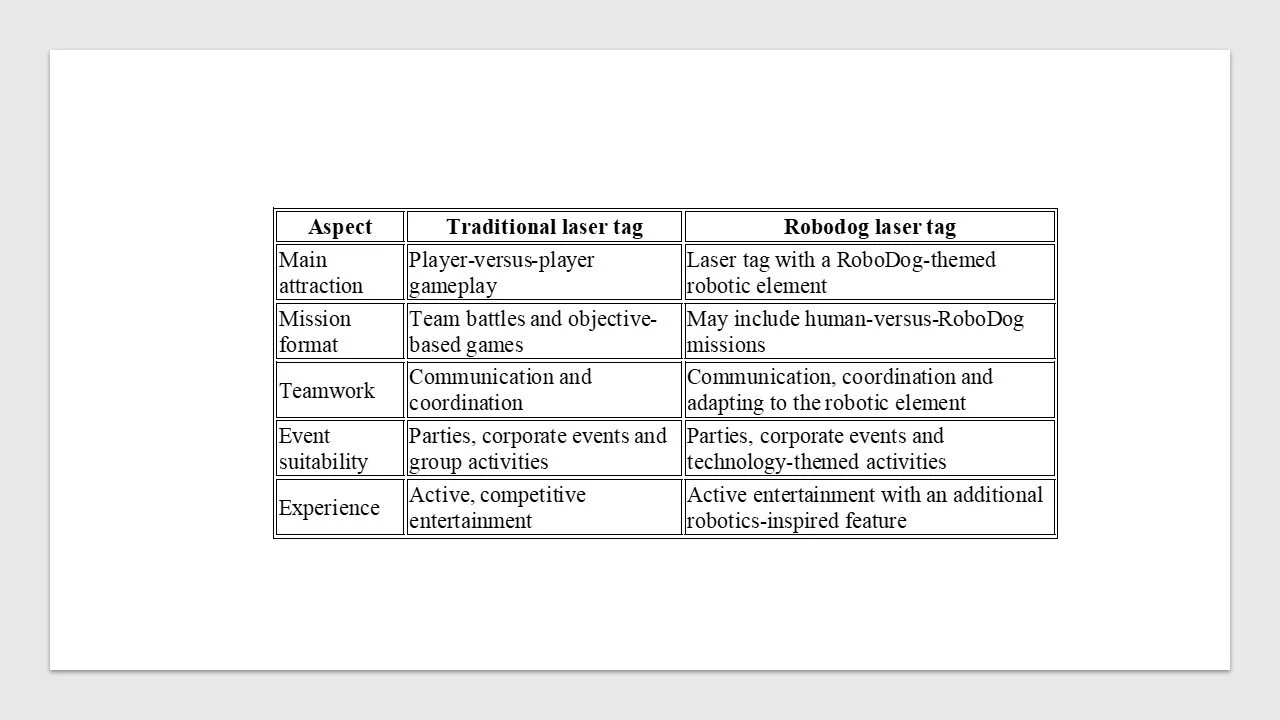
Neither format is automatically better for every group. Instead, choose the one that best suits the participants and event objectives.
For further details, visit TAG TEAM's laser tag with RoboDog birthday party experience.
Robot Dog Laser Tag Singapore: How TAG TEAM Brings RoboDog to Events
For organisers searching for robot dog laser tag Singapore, TAG TEAM offers a practical way to bring a RoboDog-themed activity into an event.
Rather than purchasing a robot dog and developing a game independently, organisers can explore an organised experience that combines facilitation, gameplay and group participation.
TAG TEAM has been operating since 2011 and offers activities including laser tag, archery tag and team-building programmes. Its website also presents RoboDog as part of its event activity range.
Interactive missions and group participation
A major attraction of RoboDog-themed gameplay is the opportunity to make participants part of the action.
For example, a group may work together during an objective-based challenge, coordinate their movements and adapt to the activity's changing demands. Such experiences can encourage communication and shared problem-solving.
Of course, the precise activities available will depend on the event package and mission format.
Suitable for corporate team building
Corporate events often aim to achieve more than entertainment. They can also create opportunities for colleagues to communicate outside their usual work routines.
A RoboDog laser tag session can be incorporated into a wider programme designed around teamwork, friendly competition and participation.
Organisers can explore TAG TEAM's corporate team-building options to learn more about its laser tag and RoboDog activities.
An option for birthday parties and family events
For birthday celebrations, an interactive robotic activity can provide a distinctive theme for guests.
Children can enjoy the novelty of a robot-themed mission, while adults can participate in the broader group experience. Similarly, family days can use interactive games to encourage parents, children and other relatives to spend time together.
Before confirming a booking, discuss the participants' ages, expected attendance, venue, event duration and preferred activity format with the organiser.
Indoor and outdoor event planning
The venue plays an important role in the success of any activity.
Indoor venues may provide a more controlled setting, whereas outdoor spaces can offer different movement possibilities. Nevertheless, suitability depends on the available space, flooring, weather conditions, equipment requirements and event arrangements.
TAG TEAM offers indoor and outdoor activity options across Singapore, subject to the chosen activity and venue requirements.
To determine whether RoboDog laser tag is appropriate for your event, ask about the recommended space, equipment setup, supervision and available scheduling options.
What Should You Check Before Booking a Robot Dog Experience?
Whether you are comparing robotic dog products or planning an event, a little research can help you avoid disappointment.
1. Understand what is actually included
First, establish whether you are buying a robot dog toy, hiring a robotic demonstration or booking a facilitated activity.
These options offer different benefits. A toy is something you can keep and use repeatedly, while an organised event provides a planned experience for a group.
2. Verify the robot's capabilities
If you are purchasing an AI robot dog, ask which features are genuinely supported.
Check for details about autonomous movement, voice recognition, object detection, programmable functions and compatibility with other devices. Do not assume that every product advertised as a smart robo dog includes all these capabilities.
3. Confirm age suitability and safety
For toys, review the manufacturer's recommended age and operating instructions.
For events, ask about safety briefings, protective equipment where applicable, supervision, participant requirements and emergency arrangements.
Furthermore, ensure the venue can accommodate the selected activity safely.
4. Consider group size and accessibility
For a group event, ask how many participants can play in each session and whether the programme can accommodate different fitness levels.
It is also useful to discuss any accessibility requirements or alternative participation arrangements in advance.
5. Compare value rather than price alone
The cheapest option is not necessarily the most suitable.
For a robot dog purchase, compare the supported features, durability, warranty and learning value. For an organised event, consider the equipment, facilitators, setup, activity duration and degree of customisation included in the quotation.
6. Ask about customisation
Finally, find out whether the activity can be adjusted to match your objectives.
For example, a corporate organiser may prioritise collaboration, while a birthday host may prefer a fun, straightforward mission. Clear communication helps the provider recommend a suitable format.
Frequently Asked Questions About Robot Dogs in Singapore
1. What is the difference between a robot dog, robotic dog and robo dog?
These terms generally describe the same broad category of dog-like robots. "Robot dog" is a common general term, "robotic dog" is often used in technical descriptions, and "robo dog" is a more informal expression frequently used in entertainment and product branding. Their actual capabilities depend on the specific machine.
2. Is an AI robot dog better than a regular robot dog?
Not necessarily. An AI robot dog may offer additional features, such as object recognition or more adaptive responses, while a basic robot dog may be more affordable and easier to operate. The right choice depends on your budget, intended use and desired features. Always check the manufacturer's specifications before purchasing.
3. Where can I experience a robot dog in Singapore?
You can explore organised RoboDog activities through TAG TEAM, which offers interactive robotic experiences and RoboDog-themed laser tag for events. Visit TAG TEAM's RoboDog activity page to learn about the experience and contact the company for current availability and booking details.
4. What is robot dog laser tag, and is it suitable for corporate events?
Robot dog laser tag combines conventional laser tag gameplay with a RoboDog-themed robotic element. Depending on the mission, participants may work together, pursue objectives or compete against the robotic character. It can be considered for corporate team building, subject to the group's requirements, venue suitability and available event format.
5. Can I book RoboDog laser tag for a birthday party or school event in Singapore?
TAG TEAM promotes RoboDog laser tag for birthday celebrations and offers team-building activities for groups. To check suitability for a school event, birthday party or other gathering, contact the organiser to confirm age requirements, participant capacity, venue options, pricing and available dates.
Conclusion: Discover the Excitement of RoboDog Experiences in Singapore
Although the terms robot dog, robotic dog and robo dog are often used interchangeably, they serve slightly different purposes in everyday conversation, technology discussions and marketing. A robot dog may be a simple interactive toy, a programmable educational device or an advanced machine equipped with specialised sensors. Similarly, an AI robot dog can offer additional capabilities, but its actual functions depend on the model rather than its name.
For people looking for something more interactive than a conventional robotic demonstration, robot dog laser tag offers another way to experience robotics-inspired entertainment. It combines group participation, mission-based gameplay and the excitement of a RoboDog-themed activity, making it worth considering for corporate team building, birthday celebrations, school programmes and family events.
If you are planning an event and want to explore a fresh activity for your participants, TAG TEAM can help you discover the possibilities of RoboDog laser tag and other interactive group experiences. Visit TAG TEAM's official website to explore its activity offerings and enquire about a suitable event package. Make your next gathering more engaging with a professionally organised experience, and discover how Robot Dog Singapore activities can bring people together through technology, teamwork and shared fun.
