
A Robot Dog is no longer just a futuristic machine seen in science-fiction films. Today, robotic dogs are attracting attention as interactive toys, educational tools, entertainment attractions, and even teammates in technology-powered games. In Singapore, where innovation, family-friendly activities, and immersive experiences are increasingly important, Robot Dog Singapore searches reflect a growing interest in discovering what these machines can do and where people can experience them. From children exploring robotics to colleagues competing in a robot-themed laser tag mission, robot dogs offer an exciting way to bring technology into everyday experiences.
But what makes these mechanical companions so appealing? Is an AI robot dog simply a high-tech toy, or can it offer something more meaningful? And how can families, schools, and companies in Singapore enjoy robot dog experiences without needing to purchase expensive equipment?
In this guide, we explore why robot dogs are becoming popular, how they work, their educational and entertainment benefits, and why interactive RoboDog activities are an exciting option for birthdays, school programmes, and corporate team-building events.
What Is a Robot Dog?
A robot dog is a machine designed to imitate some of the movements, behaviours, or interactive features of a real dog. Depending on its design, it may walk on four legs, respond to commands, avoid obstacles, perform tricks, recognise certain inputs, or interact with people through programmed behaviours.
However, not every robotic dog uses artificial intelligence. Some models follow pre-programmed routines, while others use cameras, sensors, software, and machine-learning techniques to respond to their surroundings.
In simple terms, a robot dog combines robotics, electronics, mechanical movement, and software to create an interactive experience.
How is an AI robot dog different from a regular robotic dog?
The terms robot dog, robotic dog, AI robot dog, and RoboDog are often used interchangeably. Nevertheless, there are important differences.
· Robot dog: A broad term for a dog-like robot, whether basic or advanced.
· Robotic dog: Another general term for a mechanically operated dog-like machine.
· AI robot dog: A robotic dog that uses artificial intelligence for certain tasks, such as interpreting sensor data or recognising patterns.
· Robot dog toy: A toy designed primarily for play, companionship, movement, or entertainment.
· Robo dog or Robodog: Informal names commonly used for robotic dogs and robot-dog experiences.
For example, a basic robot dog toy may perform a fixed sequence of movements when a button is pressed. By contrast, a more sophisticated robotic platform may use sensors to detect obstacles and adjust its movement.
The key point is that the label alone does not tell you how intelligent a machine really is. Its actual capabilities depend on the hardware, software, and features included by the manufacturer or event provider.
Why Are Robot Dogs Becoming Popular in Singapore?
Singapore has a strong interest in technology, interactive learning, family entertainment, and experiences that bring people together. Robot dogs sit at the intersection of these interests.
Rather than simply watching technology on a screen, people can see a machine move, respond, and participate in an activity. This hands-on element makes robotic dogs particularly interesting for children, families, educators, event organisers, and corporate teams.
Here are seven reasons why robot dogs are attracting attention.
1. Robot dogs make technology feel real
Many people encounter artificial intelligence through smartphones, websites, voice assistants, or digital applications. Although these tools can be useful, their technology often remains invisible.
A robot dog makes technology easier to observe. Participants can watch its legs move, see how it responds to commands, and explore how sensors and software help it perform different actions.
As a result, a complex subject such as robotics becomes more tangible. Children can ask questions, adults can explore new technology, and groups can learn through direct interaction.
This is one reason a robotic dog can be more memorable than a conventional technology demonstration.
2. They combine entertainment with learning
A robot dog can be entertaining without being purely recreational. Depending on the equipment and activity, participants may learn about movement, sequencing, sensors, control systems, and problem-solving.
For instance, guiding a robotic dog through an obstacle course requires participants to observe its position, consider the next step, and adjust their instructions when necessary.
Similarly, a structured coding activity can demonstrate how a sequence of commands produces a specific result.
Consequently, robot dogs can support educational experiences that combine play with STEM concepts. The precise learning value depends on the activity design, the age of the participants, and whether an instructor explains the technology behind the experience.
3. Robot dogs offer something different from ordinary toys
Traditional toys remain popular because they encourage imagination and creative play. However, an interactive robot dog can add movement, electronic responses, remote control, and sometimes voice-command functionality.
For children who enjoy technology, this creates a different kind of play experience.
A robot dog toy might walk, turn, dance, or respond to a controller. More advanced models may offer additional sensors or programmable behaviours. Even so, buyers should compare actual features rather than assume every product includes advanced AI.
For families in Singapore, robotic dogs can also be a way to introduce children to robotics without immediately committing to a complex coding kit or expensive educational setup.
4. Interactive experiences create stronger memories
People often remember activities in which they participate rather than simply observe.
A robot dog that moves through an arena, performs a trick, or becomes part of a team challenge gives participants something to discuss, photograph, and share afterwards.
This is particularly valuable for birthday celebrations, school events, family days, and company gatherings. The robot becomes part of the experience rather than just another item on display.
Moreover, interactive technology can appeal to participants with different interests. Some may enjoy controlling the robot, while others prefer observing its movements, planning a strategy, or working with teammates.
5. Robot dogs fit modern team-building activities
Corporate team-building programmes need more than entertainment alone. A well-designed activity should encourage communication, collaboration, planning, and shared problem-solving.
Robot dog challenges can provide a fresh setting for these goals.
For example, participants might need to coordinate instructions, plan a route, complete an objective, or work together during a robot-themed laser tag mission. Such tasks create opportunities for colleagues to communicate outside their normal workplace roles.
For companies searching for innovative team-building activities in Singapore, combining robotic technology with a structured group challenge can make an event feel more distinctive.
6. They appeal to different age groups
A robot dog can attract both children and adults, although the appropriate experience depends on the machine and the activity.
Young children may enjoy its movements and interactive tricks. Older students might be interested in programming or understanding its sensors. Adults may find the engineering interesting or enjoy competing in a team-based game.
This broad appeal makes robotic dogs useful for mixed-age gatherings. Nevertheless, event organisers should confirm age suitability, accessibility, supervision, and the physical requirements of the activity before booking.
7. Robot dogs make events more distinctive
Event organisers frequently look for activities that guests have not experienced many times before.
A robot dog can provide a technology-themed attraction that stands apart from traditional games. It can serve as a demonstration, a photo opportunity, a supervised interactive station, or part of a larger mission.
In Singapore's competitive event market, this flexibility can help a birthday celebration, school programme, or corporate event feel fresh and engaging.
How Does a Robot Dog Work?
A robot dog combines mechanical components, electronic controls, and software. More advanced models may also use artificial intelligence, computer vision, and multiple sensors.
Although designs vary, several core technologies explain how robotic dogs operate.
Motors and mechanical movement
A quadruped robot uses motors or actuators to move its legs and position its body. The control system coordinates these movements so the machine can stand, walk, turn, or perform specific actions.
More advanced robots may adjust their balance and movement in response to changes in the ground or obstacles. Simpler models may instead follow a fixed pattern.
Sensors and environmental awareness
Sensors help a robot collect information about its surroundings. Depending on the model, these may include distance sensors, cameras, motion sensors, or other electronic components.
The robot's software interprets the available information and uses it to support particular behaviours. For example, a sensor may detect an obstacle and trigger a programmed response.
However, sensor capability varies significantly. A robot that detects nearby objects should not automatically be assumed to recognise faces, understand speech, or navigate every environment independently.
Software and artificial intelligence
Software determines how the robot responds to its inputs. In a basic system, the software may execute instructions in a predetermined order.
In an AI-enabled system, machine-learning models may help interpret sensor data or select actions in more complex situations. Some systems can improve their performance through training, while others rely mainly on rules and preconfigured behaviours.
Therefore, the phrase AI robodog should describe a machine with relevant AI capabilities, not simply any robotic dog with electronic controls.
Robot Dog vs Robot Dog Toy: Which Is Better?
One of the most common questions from prospective buyers is whether to choose a robot dog toy or a more advanced robotic platform.
The right choice depends on the intended purpose, budget, age group, and desired level of interaction.
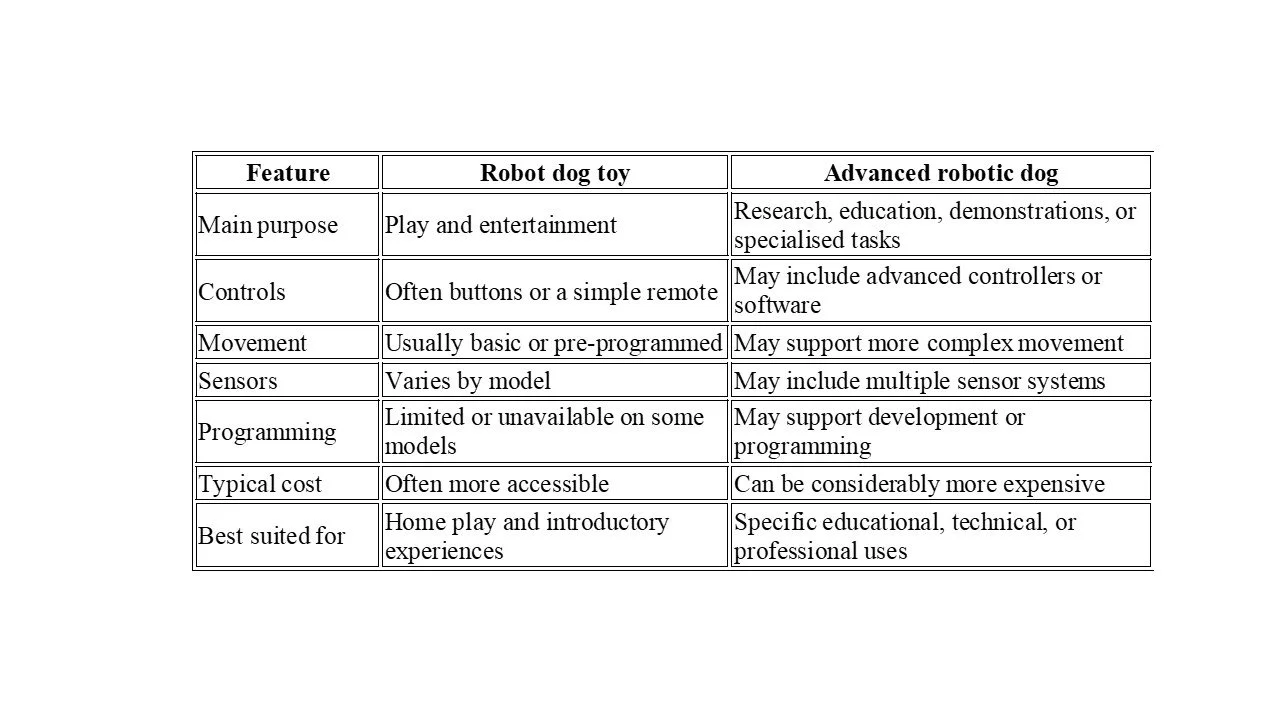
These are general distinctions rather than fixed rules. Some affordable educational robot dogs support coding, while certain advanced machines are designed for a narrow purpose rather than general interaction.
What should you look for in the best robo dog?
If you are searching for the best robo dog for personal use, consider the following factors before purchasing.
Age suitability: Check the manufacturer's recommended age and any small-part, battery, or supervision warnings.
Movement and interaction: Decide whether you want simple walking and tricks or more sophisticated control and programming.
Battery life: Check the expected operating time and charging requirements.
Durability: Consider whether the robot will be used gently indoors or in a more demanding environment.
Educational features: If learning is important, look for clear instructions, programming support, or activities suited to the user's skill level.
After-sales support: Confirm warranty coverage, spare-part availability, and access to technical assistance.
Privacy: If the robot has a camera, microphone, or internet connection, review how recordings and personal data are handled.
Ultimately, the best robo dog is the one that suits your intended use. A family seeking an entertaining toy may need very different features from a school planning a robotics workshop.
Where Can You Experience a Robot Dog in Singapore?
Buying a robot dog is not the only way to explore this technology. For many families, students, and companies, an organised interactive session is a convenient way to experience robotic activities without having to purchase, maintain, or store equipment.
When comparing options in Singapore, consider whether the provider offers a demonstration, supervised interaction, an educational component, or a group activity.
For people who prefer active entertainment, a robot dog integrated into a game can offer something more engaging than a standalone display.
Discover TAG TEAM's interactive RoboDog experience
TAG TEAM Pte Ltd has organised event activities in Singapore since 2011, with offerings that include laser tag, archery tag, and team-building programmes. Its RoboDog experience adds a technology-focused element to group entertainment.
According to TAG TEAM's RoboDog activity page, participants can explore activities such as obstacle courses, fetch games, demonstrations, voice-command games, and photo opportunities. The experience can be relevant to families, groups of friends, and corporate teams looking for an interactive activity.
Instead of only reading about robotic technology, participants can see the RoboDog in action and take part in activities designed around it.
This makes the experience suitable for people who are curious about robot dogs but do not necessarily want to buy one for home use.
What Makes Robot Dog Laser Tag in Singapore Different?
A particularly engaging way to experience a robot dog is to incorporate it into a team game.
Traditional laser tag already combines movement, friendly competition, and strategy. Adding a robotic dog creates a different type of challenge because participants must respond to an unexpected element within the game.
Rather than simply competing against the opposing team, players may need to coordinate around a robot-themed mission, follow instructions, or adapt their strategy as the activity unfolds.
How does Robodog laser tag work?
The exact format depends on the provider and event package. In a robot-themed laser tag experience, the RoboDog becomes part of the mission or entertainment format.
Participants receive a briefing, learn the rules, and then work towards the objective set by the facilitators. The robot may act as a featured opponent or participate in the scenario, depending on the activity.
At TAG TEAM, the corporate events page describes its RoboDog laser tag concept as a human-versus-RoboDog mission. This gives teams a distinctive way to experience laser tag alongside interactive robotic entertainment.
For details, visit TAG TEAM's corporate team-building page.
Why choose robot dog laser tag instead of a standard game?
There are several reasons a robot-themed mission may appeal to event organisers.
· A novel experience: The robotic element makes the activity different from a conventional laser tag session.
· Team coordination: Players need to communicate, share information, and work towards a common objective.
· Active participation: Participants become part of the mission rather than remaining spectators.
· Memorable moments: The combination of robotics and friendly competition gives groups something distinctive to remember.
· Flexible event planning: A robot-themed mission may be incorporated into a broader event programme, depending on the provider's available packages.
Importantly, the value of the experience is not just the technology. The briefing, game design, facilitation, and group interaction all contribute to the overall event.
Who should consider Robodog laser tag Singapore?
Corporate teams: Companies can use interactive missions to create opportunities for communication and collaboration outside the usual office environment.
Schools and student groups: A supervised, age-appropriate activity can introduce students to robotics in an engaging setting. Organisers should confirm the suitability of the specific programme for their students.
Birthday celebrations: Children who enjoy technology, action games, and unusual experiences may appreciate a robot-themed laser tag party.
Family days: A shared activity can encourage parents, children, and other relatives to participate together.
Private groups: Friends and community groups may enjoy trying an activity that combines technology and friendly competition.
For a group considering robot dog laser tag Singapore, the best option is one that fits the participants' ages, group size, venue, and event objectives.
Robot Dog Singapore: An Innovative Option for Birthday Parties
Planning a birthday party involves balancing entertainment, convenience, age suitability, and budget. A robot dog activity can add a distinctive theme for children who enjoy robotics and interactive games.
However, an engaging party does not need to be complicated. A well-organised event with a clear briefing, suitable activities, and experienced facilitators can help everyone participate comfortably.
Why consider a RoboDog birthday experience?
A RoboDog-themed activity can provide a combination of technology, movement, and group participation.
Children may enjoy watching the robot perform, taking part in guided activities, or experiencing it as part of a laser tag mission. The specific options depend on the chosen package and equipment.
TAG TEAM offers laser tag birthday party experiences, including a RoboDog-themed mission in which children can learn to control the RoboDog and team up with it during the game.
For parents, a hosted activity can also simplify planning because the provider handles the game setup and facilitation according to the selected arrangement.
Before booking, ask about the recommended age range, venue requirements, supervision, activity duration, weather arrangements for outdoor events, and any package-specific charges.
How Robot Dogs Can Support STEM Learning in Singapore
Robot dogs can provide a practical starting point for conversations about science, technology, engineering, and mathematics.
Instead of learning about engineering only through textbooks, students can observe how a machine moves and investigate the ideas behind its behaviour.
Learning about programming and logical thinking
When a robot follows a series of instructions, learners can explore the relationship between commands and outcomes.
For example, a simple activity might ask students to make a robot move forward, turn, and stop at a designated point. If the robot does not reach the target, students can examine the sequence and identify what needs to change.
This process encourages logical thinking, experimentation, and problem-solving.
Exploring sensors and feedback
A sensor provides information that a robot can use to respond to its environment. A supervised demonstration can help learners understand how detecting an obstacle differs from recognising an object.
Students can also discuss why sensors sometimes produce imperfect results and why engineers need to test systems in different conditions.
Connecting robotics with teamwork
Group activities can make technical learning more collaborative. One student might plan the route, another might operate the controller, and another might observe the result and suggest improvements.
As a result, a robotics activity can encourage communication as well as technical curiosity.
Nevertheless, the educational value depends on how the session is structured. A robot dog demonstration is not automatically a complete STEM lesson. For deeper learning, organisers should include explanations, questions, and opportunities for participants to experiment.
Are Robot Dogs Safe for Children and Public Events?
Safety should be an important consideration whenever a robotic device is used around people.
A robot dog may contain moving joints, motors, batteries, electronic components, and, in some models, cameras or other sensors. Its physical design and operating behaviour determine the precautions required.
For children and public events, organisers should consider the following measures:
· Follow the manufacturer's operating instructions and age recommendations.
· Keep hands, clothing, and loose objects away from moving parts.
· Use the robot in an appropriate space with clear movement boundaries.
· Provide supervision and explain how participants should interact with the equipment.
· Inspect equipment and batteries according to the provider's procedures.
· Keep charging equipment and cables managed safely.
· Review privacy arrangements if cameras, microphones, or recordings are involved.
For robot dog laser tag activities, participants should also receive a briefing on the game rules, equipment use, and designated play area.
A professional event provider should explain the activity format and relevant safety arrangements before the event begins. If you are organising a school or corporate programme, discuss any accessibility needs, medical considerations, or venue restrictions in advance.
What Are the Limitations of Robot Dogs?
Although robot dogs can be entertaining and technically impressive, they are not replacements for real animals or human judgement.
First, their abilities vary widely. A basic model may perform only a limited set of programmed movements, while a sophisticated platform may support more advanced navigation or perception.
Second, battery life can restrict operating time. Some machines also require specialist maintenance, suitable surfaces, or careful handling.
Third, an AI robot dog does not necessarily understand people in the same way a human or animal does. A response that appears intelligent may be generated by a programmed routine or a system trained for a narrow task.
Finally, more features can mean more complexity. Cameras, microphones, connectivity, and software updates may introduce privacy, security, or maintenance considerations.
Understanding these limitations helps buyers and event organisers set realistic expectations. It also makes it easier to choose an activity that delivers the experience they actually want.
Is It Better to Buy a Robot Dog or Book an Experience?
There is no single answer because the best choice depends on how often you plan to use the robot and what you want to achieve.
Buying a robot dog toy may make sense for a family that wants regular play at home. An educational model may be more suitable for someone interested in programming and experimentation.
However, if your goal is to entertain a group for a birthday, school event, or corporate gathering, booking an organised experience may be more practical.
A hosted activity can provide access to equipment, instructions, and a planned programme without requiring you to research models, purchase the device, or manage its maintenance.
Consider these questions before deciding:
1. Will the robot be used regularly or only for a special event?
2. Is the main objective home entertainment, STEM learning, or group bonding?
3. Do you need to own the equipment?
4. Would a facilitated group activity provide more value?
5. What are the venue, age, accessibility, and budget requirements?
By answering these questions, you can decide whether a purchase or a hosted activity better matches your needs.
How to Choose the Right Robot Dog Experience in Singapore
If you are comparing robotic dog activities in Singapore, use the following checklist to make a confident decision.
Define your purpose. Decide whether you want a technology demonstration, a children's activity, a team-building mission, or a robotics learning session.
Check the activity details. Ask what participants will actually do and whether the experience includes hands-on control, demonstrations, obstacle courses, or a laser tag mission.
Confirm suitability. Check age recommendations, group size, accessibility, and any physical requirements.
Understand the logistics. Ask about venue arrangements, event duration, equipment, staffing, weather contingencies, and setup time.
Review the provider's experience. Look for clear information about event organisation, facilitation, and the types of groups the provider serves.
Request a tailored quotation. Pricing may depend on the selected activity, duration, location, and package. Confirm the complete cost before making a booking.
For event organisers, these practical checks are just as important as the robot itself. A well-matched programme helps ensure the technology enhances the event rather than complicating it.
Frequently Asked Questions About Robot Dogs in Singapore
1. What is a robot dog, and how does it work?
A robot dog is a dog-shaped machine that uses mechanical components, electronic controls, and software to perform movements or interactive behaviours. Some models follow pre-programmed instructions, while more advanced systems may use sensors and artificial intelligence to interpret information and respond to their surroundings. Capabilities vary by model.
2. Where can I experience a robot dog in Singapore?
You can explore organised RoboDog activities through providers offering robotic demonstrations or interactive group experiences. TAG TEAM features RoboDog activities such as obstacle courses, fetch games, demonstrations, and robot-themed laser tag. Visit the TAG TEAM RoboDog page to review the available experience and enquire about arrangements.
3. Is a robot dog toy suitable for children?
Some robot dog toys are designed for children, but suitability depends on the model, recommended age, moving parts, battery design, and supervision requirements. Check the manufacturer's instructions before purchasing. For organised activities, confirm the age suitability and safety arrangements with the event provider.
4. What is robot dog laser tag in Singapore?
Robot dog laser tag combines a laser tag game with a robotic dog as part of the mission or experience. The exact format varies by provider. TAG TEAM offers a RoboDog-themed laser tag concept for group activities, including corporate events and birthday celebrations. Participants should check the specific package details before booking.
5. Is it better to buy a robot dog or book a RoboDog activity?
Buying a robot dog may be appropriate if you want to use it regularly at home or explore programming over time. Booking a RoboDog activity may be more practical for a one-off celebration, school programme, or corporate event because the experience can include equipment, facilitation, and a planned activity. The better option depends on your goals, budget, and how frequently you expect to use the technology.
Conclusion: Discover the Excitement of Robot Dogs with TAG TEAM
Robot dogs are becoming popular because they bring technology to life through movement, interaction, learning, and play. From a simple robot dog toy to an advanced AI robot dog, these machines offer different ways to explore robotics and discover how software and engineering can create engaging experiences.
In Singapore, their appeal extends beyond technology enthusiasts. Families can explore robot-themed entertainment, schools can introduce students to robotics concepts, and companies can use interactive challenges to encourage teamwork. Meanwhile, robot dog laser tag adds another dimension by combining robotic entertainment with strategy, communication, and friendly competition.
The best experience is one that matches your group's interests, age range, venue, and objectives. Rather than focusing only on the machine, consider the quality of the activity, the guidance provided, and the memories your participants can create together.
Ready to bring a robot-themed adventure to your next event? Explore TAG TEAM's RoboDog experience, discover corporate team-building activities, or plan a laser tag birthday party. Contact TAG TEAM to discuss your event requirements and find out which options are suitable for your group. If you are searching for an engaging Robot Dog Singapore experience, TAG TEAM can help you explore an interactive way to bring people together through technology, teamwork, and fun.
